
The first look into my car at the towing yard gave me a mixed response.
My first thought was: "wow, they cleaned the car for me!" Then I saw the empty box of cigarettes and the food stains and sand on the passenger seat. Cleaner due to the lack of my junk, but not particularly clean.
Otherwise, besides the missing stereo and almost completely empty gas tank, they had tried to do the right thing:
opening up the glove compartment revealed an unopened bottle of beer.
Monday, November 28, 2005

Monday, November 21, 2005
making an academic career
A friend sent me a link to this essay on how to do professional networking, particularly in academics. I haven't read the whole thing, but it seems interesting so far. One point I appreciated was about how you need to make your own network rather than just joining another.
Actually the essay covers more than this. It covers some of the nuts and bolts of academic exchange.
Actually the essay covers more than this. It covers some of the nuts and bolts of academic exchange.
Sunday, November 20, 2005
paradise now
This movie about suicide bombers actually has some things structurally in common with the play Marius mentioned in my last post. Love and friendship and life on the one hand, dying for a larger cause on the other (no matter how misguided it might be). It was somewhat of a painful movie to watch, but the friendship and general politics and philosophy were rich enough that the hair raising action plot wasn't too upsetting. It felt like a balanced movie to me, giving me a feel for some of the complexities in the Israeli Palestinean struggle which I hear a lot about and feel like I know little about.
Thursday, November 17, 2005
Incompetent Design Song
Seed Magazine interviews one of the proponents of a bold new theory: incompetent design! Here is their theme song.
Sunday, November 13, 2005
public science
There have been some interesting discussions going on about public presentation of science at Cosmic Variance. See here and here for two related threads. When I say "public", I'd like to avoid the implication of a highly educated small special group versus a less educated large group of outsiders. I mean it more in the general sense of individual versus group communications. Using this meaning of public, I notice that some physicists show lesser and greater degrees of maturity in these debates. By maturity, I mean awareness with respect to one's role in the public debate. I think that some physicists have the attitude that everyone is as argumentative as they are and has equally strong opinions. But when you study a certain thing a lot, you are bound to have opinions about it that someone else can't really have, and this gives you both an authority and a responsibility to be careful with what you say. I think that some physicists want the former but don't know how to deal with the latter. Its a lot of work to try to understand one's audience so that one can understand the influence one has over that audience.
I'm not sure how clear that is, and if you read some of the discussion on the links I gave, I'm not sure how obviously relevant what I said is. I guess I'm trying to point out that physicists are not so good at this kind of debate. These issues underlie discussions, but many are not personally comfortable enough with them to deal with it in a responsible way. I hope that more public discussions like these will continue to take place and some physicists will gain maturity and humility in the process. I think that in this particular case, its really important that there is someone like Clifford Johnson who is well respected in his field, but also has good people skills and a sense of fairness and kindness, that balances the discussion and keeps it civil and productive. Some might argue that his bringing Lawrence Krauss to task in so public a way is mean and uncalled for, but because he backs up his criticisms with arguments and stands by them, putting energy and time into the ensuing debate, I think it was a bold and valuable thing to do.
I'm not sure how clear that is, and if you read some of the discussion on the links I gave, I'm not sure how obviously relevant what I said is. I guess I'm trying to point out that physicists are not so good at this kind of debate. These issues underlie discussions, but many are not personally comfortable enough with them to deal with it in a responsible way. I hope that more public discussions like these will continue to take place and some physicists will gain maturity and humility in the process. I think that in this particular case, its really important that there is someone like Clifford Johnson who is well respected in his field, but also has good people skills and a sense of fairness and kindness, that balances the discussion and keeps it civil and productive. Some might argue that his bringing Lawrence Krauss to task in so public a way is mean and uncalled for, but because he backs up his criticisms with arguments and stands by them, putting energy and time into the ensuing debate, I think it was a bold and valuable thing to do.
Thursday, November 03, 2005
finding the center
I find myself wondering whether grey exists on its own terms, or whether there are only mixtures of black and white.
Is there a place to live between yes and no? between left eye open and right eye open? between mom and dad?
Its common to point out that much of news coverage has degenerated now to "he said, she said", that "balance" means superposition of polarity. But this rhetorical move from my situation to the general culture is too easy and too self-indulgent. I take my title from a book on pottery I remember seeing at my friend Peter's mom's house. The initial stage of throwing involves centering. If you blur your eyes, a spinning piece of clay will look centered, but your hands know its not, and when it stops spinning, it must choose an orientation unless it is truly centered.
Enough metaphor. (Mixing my metaphors?) Enough hiding in generalities. Time to take this to heart. Time to choose. But to create at the same time: to find reality in my own grey perspective.
Is there a place to live between yes and no? between left eye open and right eye open? between mom and dad?
Its common to point out that much of news coverage has degenerated now to "he said, she said", that "balance" means superposition of polarity. But this rhetorical move from my situation to the general culture is too easy and too self-indulgent. I take my title from a book on pottery I remember seeing at my friend Peter's mom's house. The initial stage of throwing involves centering. If you blur your eyes, a spinning piece of clay will look centered, but your hands know its not, and when it stops spinning, it must choose an orientation unless it is truly centered.
Enough metaphor. (Mixing my metaphors?) Enough hiding in generalities. Time to take this to heart. Time to choose. But to create at the same time: to find reality in my own grey perspective.
Sunday, October 16, 2005
green gulch
This morning I managed to drag myself out of an unpleasant physics dream and drove across the bridge to Green Gulch Zen center. This was the first time I'd gone. The Dharma Talk for today was by Meiya Wender. She spoke of many interesting things in a way that was both personal and intellectual; a combination, together with clarity, I really respect.
The talk centered around a piece of caligraphy she recieved from a 105 year old man that said something like, "the flower falls and is swept away by the stream." She spoke about duty: duty to communtiy, or even civic duty. She said that American culture lacks humility, lacks the ability to ask for help, lacks a sense of home. The flower is at home as it is swept away by the stream.
She gave the example of the yoga guru Iyengar who recently spent a large amount of the money he made from his fame on improving the physical and educational infrastructure of the village he grew up in. She imagined that this flowed naturally from him: "the left hand bandages the right hand without asking whether or when it will be payed back". She also talked about her father whose mother died at a young age and was put in an orphanage by his father. He immigrated to the US and eventually became a successful business person. She said that he had the attitude that he had gotten to where he was mainly as a result of his own striving. If this is your atittude, then where is the community to give back to? Meiya Wender asked. I could relate to this question. Not because I haven't gotten lots of help, and lots of good fortune in my life, but because I do feel like I'm a pretty independent person trying to do as much by myself as possible. I asked her about this point later on in a discussion group. She acknowledged the question and the difficulty of doing this. How does one identify the community to be grateful to if it seems so dispersed? In addition to family and friends, I must be grateful to the rest of the world that to some (perhaps great) extent the possibilities in the US are responsible for. Can I feel this gratitude and find empathy when I hear about earthquakes and hurricanes? In my own situation, with a somewhat complicated family, I've always felt that bridging the gaps to identify such a "community" is a difficult, but somehow necessary task.
Anyway, it was a nice morning. At the end, they serve lunch- today was split pea soup, good bread and butter and a green salad with tasty cherry tomatoes and avocado. The meditation was hard, but seemed somewhat useful, and the talk and discussion felt surprisingly relevant. Asking for help, feeling part of community, giving back: things I struggle with.
The talk centered around a piece of caligraphy she recieved from a 105 year old man that said something like, "the flower falls and is swept away by the stream." She spoke about duty: duty to communtiy, or even civic duty. She said that American culture lacks humility, lacks the ability to ask for help, lacks a sense of home. The flower is at home as it is swept away by the stream.
She gave the example of the yoga guru Iyengar who recently spent a large amount of the money he made from his fame on improving the physical and educational infrastructure of the village he grew up in. She imagined that this flowed naturally from him: "the left hand bandages the right hand without asking whether or when it will be payed back". She also talked about her father whose mother died at a young age and was put in an orphanage by his father. He immigrated to the US and eventually became a successful business person. She said that he had the attitude that he had gotten to where he was mainly as a result of his own striving. If this is your atittude, then where is the community to give back to? Meiya Wender asked. I could relate to this question. Not because I haven't gotten lots of help, and lots of good fortune in my life, but because I do feel like I'm a pretty independent person trying to do as much by myself as possible. I asked her about this point later on in a discussion group. She acknowledged the question and the difficulty of doing this. How does one identify the community to be grateful to if it seems so dispersed? In addition to family and friends, I must be grateful to the rest of the world that to some (perhaps great) extent the possibilities in the US are responsible for. Can I feel this gratitude and find empathy when I hear about earthquakes and hurricanes? In my own situation, with a somewhat complicated family, I've always felt that bridging the gaps to identify such a "community" is a difficult, but somehow necessary task.
Anyway, it was a nice morning. At the end, they serve lunch- today was split pea soup, good bread and butter and a green salad with tasty cherry tomatoes and avocado. The meditation was hard, but seemed somewhat useful, and the talk and discussion felt surprisingly relevant. Asking for help, feeling part of community, giving back: things I struggle with.
Saturday, October 15, 2005
reductionism and monogamy
I can't stop thinking of this question of why elementary science is seen as more exciting than model building in less "elementary" science.
I think this attitude comes from our realist view of the objects of our theories. But it is a selective realist view, at least for the hard core ideologues. They take as real only those elements in our fundamental most reduced theories. This is the source of the often quoted statement that most of supposedly solid matter is "really" empty space. I would say that the fact that one can't move something else into a certain space makes a pretty good case for it not being empty. But if one takes the perspective of an electron, then yes, there is a possibility of moving into the space inside that chair over there. Or, more precisely, the way in which we describe the microscopic details of the atomic structure of the wood in the chair involves a somewhat thin probability wave of electrons moving throughout otherwise empty space. We forget that this itself is a model, that in fact one should use quantum field theory, although perhaps the same conclusion about the emptiness of space could follow with some kind of interpretation of how likely it is to find a chunk of field somewhere.
Now, if we take only the elements of our fundamental theory to be real and think of those of less elementary theories as composite, then its clear that the excitement for those adventurous types is in finding new elementary entities. It is sort of like the difference between the excitement of dating many people or building a relationship with one person. The "mistake" of the one who never builds relationships is in thinking that once the basic elements of something are identified, nothing particularly interesting can come of those elements. This person is always on the search for new basic elements, not realizing that there is an equally rich gain as one ascends the hierarchy. I'm tempted to point out that this is the percieved "male" reproductive strategy and to wonder whether this is one of the points that has been raised by feminists and cultural critics who have claimed that much of science is dominantly male in essence. But I'm venturing off into fields unknown and hence risking the ever worrisome label of "crackpot".
I think this attitude comes from our realist view of the objects of our theories. But it is a selective realist view, at least for the hard core ideologues. They take as real only those elements in our fundamental most reduced theories. This is the source of the often quoted statement that most of supposedly solid matter is "really" empty space. I would say that the fact that one can't move something else into a certain space makes a pretty good case for it not being empty. But if one takes the perspective of an electron, then yes, there is a possibility of moving into the space inside that chair over there. Or, more precisely, the way in which we describe the microscopic details of the atomic structure of the wood in the chair involves a somewhat thin probability wave of electrons moving throughout otherwise empty space. We forget that this itself is a model, that in fact one should use quantum field theory, although perhaps the same conclusion about the emptiness of space could follow with some kind of interpretation of how likely it is to find a chunk of field somewhere.
Now, if we take only the elements of our fundamental theory to be real and think of those of less elementary theories as composite, then its clear that the excitement for those adventurous types is in finding new elementary entities. It is sort of like the difference between the excitement of dating many people or building a relationship with one person. The "mistake" of the one who never builds relationships is in thinking that once the basic elements of something are identified, nothing particularly interesting can come of those elements. This person is always on the search for new basic elements, not realizing that there is an equally rich gain as one ascends the hierarchy. I'm tempted to point out that this is the percieved "male" reproductive strategy and to wonder whether this is one of the points that has been raised by feminists and cultural critics who have claimed that much of science is dominantly male in essence. But I'm venturing off into fields unknown and hence risking the ever worrisome label of "crackpot".
Thursday, October 13, 2005
model building in physics
I've been doing some reading for a history of science class.
There was an interesting article by Steven Weinberg on his views of Kuhn's "Structure.."
There was also in interesting article by Philip Anderson on emergent properties. He says that the reductionist assumption doesn't imply the "constructionist" assumption. As far as construction, he focusses on the issue of symmetry breaking and notes how complexity can approximately break a symmetry or introduce a new one.
I already knew this, but it emphasized two aspects to physics research. One is finding an appropriate model for a situation. The other is grounding that model in lower level laws. The lower level laws may or may not be the original inspiration for the model.
I went to an ice cream party at slac yesterday celebrating the achievement of 10^34 1/cm/s luminosity in PEP-II. I was talking to some particle physicists and one of them made the usual comment that accelerator physics "is just applied electromagnetism". I agree with this statement except for the implications of the word "just". As one moves up the reduction/construction ladder, one adds new elements, boundary conditions is perhaps a technical way of saying it that are really just approximate in the underlying theory. But why am I doing degenerate perturbation theory on symplectic matrices and working with stochastic differential equations? Am I really "just" applying Maxwell's equations?
I like this topic and I'd like to discuss it in a way that goes beyond sour grapes at not getting my fair share of respect. The article by Anderson closes by saying something like that perhaps we've gone beyond the arrogance of particle physicists thinking that all science is applied quantum field theory. But that we have a long way to go to get beyond the biologists thinking that all psychology and genetics is "just" applied biology. He suggests that there are probably many more hierarchicaly significant levels between human behavior and biology than between say chemistry and quantum field theory.
Why is it that supposedly "smart" people (like myself) need to constantly be reminded of such obvious things. I think it has to do with what I wrote awhile ago about the problems of focussing too much on one particular area and the (necessary?) lack of perspective that can result.
There was an interesting article by Steven Weinberg on his views of Kuhn's "Structure.."
There was also in interesting article by Philip Anderson on emergent properties. He says that the reductionist assumption doesn't imply the "constructionist" assumption. As far as construction, he focusses on the issue of symmetry breaking and notes how complexity can approximately break a symmetry or introduce a new one.
I already knew this, but it emphasized two aspects to physics research. One is finding an appropriate model for a situation. The other is grounding that model in lower level laws. The lower level laws may or may not be the original inspiration for the model.
I went to an ice cream party at slac yesterday celebrating the achievement of 10^34 1/cm/s luminosity in PEP-II. I was talking to some particle physicists and one of them made the usual comment that accelerator physics "is just applied electromagnetism". I agree with this statement except for the implications of the word "just". As one moves up the reduction/construction ladder, one adds new elements, boundary conditions is perhaps a technical way of saying it that are really just approximate in the underlying theory. But why am I doing degenerate perturbation theory on symplectic matrices and working with stochastic differential equations? Am I really "just" applying Maxwell's equations?
I like this topic and I'd like to discuss it in a way that goes beyond sour grapes at not getting my fair share of respect. The article by Anderson closes by saying something like that perhaps we've gone beyond the arrogance of particle physicists thinking that all science is applied quantum field theory. But that we have a long way to go to get beyond the biologists thinking that all psychology and genetics is "just" applied biology. He suggests that there are probably many more hierarchicaly significant levels between human behavior and biology than between say chemistry and quantum field theory.
Why is it that supposedly "smart" people (like myself) need to constantly be reminded of such obvious things. I think it has to do with what I wrote awhile ago about the problems of focussing too much on one particular area and the (necessary?) lack of perspective that can result.
Sunday, October 02, 2005
submitted
I'm sure someone's sitting around ready to read submissions at 3 AM Sunday morning.
Now, I hope to hear something by tomorrow afternoon...
The next challenge is to wake up at 8 and pack.
Now, I hope to hear something by tomorrow afternoon...
The next challenge is to wake up at 8 and pack.
Friday, September 30, 2005
ten
abbas kiarostami.
I saw "The Taste of Cherry", when, six months ago? Did I get it at the library? I suppose.
Here are two films. "Ten" is filmed in a car. In Tehran? I guess.
Mother and son. The mother has divorced her husband, telling a court that he was a drug adict. She tries to convice her son (I can't remember, 8 years old?) that she is right and to talk to him about her life. He is not interested. He doesn't understand her problems and understands this and that what she is telling him is inappropriate. They are both miserable in their own ways. I started with my sympathies with the boy. He seems to be less manipulative than the mother, trying to have direct conversations but to not be quite developed enough to take on this role. The mother didn't make much effort to speak in a way that took him into account, to change her way of speaking to respect his age and understanding of the world. This caused the boy visible discomfort and he was always ready to leave the car and was frequently covering his ears.
Then the boy is gone and we watch the mother drive around the city. She picks people up and gives them rides. An old woman going to pray at a temple. She seems more humble and grounded with these other people than with her son. They challenge her and she listens. She picks up a prostitute who is angry at first because she thought she was getting into a man's car. She lectures the prostitute on morality, but is asked to defend her own position in her marriage which she lies about, saying she is married. As the film progresses she sees her son a few more times, and we see a softening of their relationship, even though he still doesn't trust her and is ready to leave the car frequently. She decides to allow him to stay with his father. He looks happy. He tells his mother why the new woman his father is seeing is better than her. She seems amused by this. "She cooks more than one thing," he says. "Isn't it relieving that in the end, it all comes down to food?" she responds, and he is uncertain, seeming to gain a new respect for his mother.
The other film is the director driving around the roads where "Taste of Cherry" was filmed. He discusses "Ten". He talks about how one critic saw it as "violence against cinema". The fact that he uses so few camera angles and uses real people instead of actors disturbed this critic. He mentioned a certain quote by Nietzche twice: "That which is truly deep requires a mask."
He ended with a discussion of American cinema. He said his hunch was that it was more destructive than American military. He says that he is self-taught and therefore his teachings are not necesarilly connected to popular ideas or standard techniques. His friend once chastized him for "growing vegetables in a flower pot" instead of cultivating land. So he recommends that film students study American movies and understand why the formula works. He quoted someone as saying that all people have a Native American heart and in cinema one should use all the tricks at one's disposal to influence this heart. This is the secret to success of American movies. This last part seemed kind of sad. The practical words of someone who feels like what they really want to say (what he said in earlier parts of the film, perhaps) will be too dangerous because it will not be understood, and so it is better to give practical falsehoods that lead in a safer direction.
I saw "The Taste of Cherry", when, six months ago? Did I get it at the library? I suppose.
Here are two films. "Ten" is filmed in a car. In Tehran? I guess.
Mother and son. The mother has divorced her husband, telling a court that he was a drug adict. She tries to convice her son (I can't remember, 8 years old?) that she is right and to talk to him about her life. He is not interested. He doesn't understand her problems and understands this and that what she is telling him is inappropriate. They are both miserable in their own ways. I started with my sympathies with the boy. He seems to be less manipulative than the mother, trying to have direct conversations but to not be quite developed enough to take on this role. The mother didn't make much effort to speak in a way that took him into account, to change her way of speaking to respect his age and understanding of the world. This caused the boy visible discomfort and he was always ready to leave the car and was frequently covering his ears.
Then the boy is gone and we watch the mother drive around the city. She picks people up and gives them rides. An old woman going to pray at a temple. She seems more humble and grounded with these other people than with her son. They challenge her and she listens. She picks up a prostitute who is angry at first because she thought she was getting into a man's car. She lectures the prostitute on morality, but is asked to defend her own position in her marriage which she lies about, saying she is married. As the film progresses she sees her son a few more times, and we see a softening of their relationship, even though he still doesn't trust her and is ready to leave the car frequently. She decides to allow him to stay with his father. He looks happy. He tells his mother why the new woman his father is seeing is better than her. She seems amused by this. "She cooks more than one thing," he says. "Isn't it relieving that in the end, it all comes down to food?" she responds, and he is uncertain, seeming to gain a new respect for his mother.
The other film is the director driving around the roads where "Taste of Cherry" was filmed. He discusses "Ten". He talks about how one critic saw it as "violence against cinema". The fact that he uses so few camera angles and uses real people instead of actors disturbed this critic. He mentioned a certain quote by Nietzche twice: "That which is truly deep requires a mask."
He ended with a discussion of American cinema. He said his hunch was that it was more destructive than American military. He says that he is self-taught and therefore his teachings are not necesarilly connected to popular ideas or standard techniques. His friend once chastized him for "growing vegetables in a flower pot" instead of cultivating land. So he recommends that film students study American movies and understand why the formula works. He quoted someone as saying that all people have a Native American heart and in cinema one should use all the tricks at one's disposal to influence this heart. This is the secret to success of American movies. This last part seemed kind of sad. The practical words of someone who feels like what they really want to say (what he said in earlier parts of the film, perhaps) will be too dangerous because it will not be understood, and so it is better to give practical falsehoods that lead in a safer direction.
Wednesday, September 28, 2005
virtual reality
I tried out this online game called "Second Life". I can't say I played it long enough to get a feel for it, and it was really slow on my computer. I was dragged into it after seeing todays installment of Rocket Boom in which a woman talks about how she has made a business designing and selling clothes in the virtual world, but can cash the money out and live on it in real life.
I remember going on a walk through Forest Park in Portland once with two friends and thinking about virtual reality. I wondered if some day I would live in a virtual world, and I found this pretty scary. How can one tell if one is in a real world or a virtual world? Well, in a virtual world, the rules are set by code. So even if all sorts of things dramatically improve, the world only contains the rules of the code that creates it. So, by doing science experiments, one can determine if one is in a real or virtual world. Anyway, that's a pretty academic concern and maybe not even all that well posed.
But what this clumsy, somewhat annoying half hour experience trying out Second Life reminded me of was how we make compromises and trade in things for rather sad replicas of them perhaps eventually forgetting what the original inspiration was. This is the negative aspect of technological evolution, huge expanses of uncontrolled wilderness get traded for city parks, the massively complicated social ecological structures of natural life get traded for zoos and botanical gardens. What these new acquisitions/creations have that their predecessors lack is controllability. We can predict, control and mold them to our desires/needs.
Now here's the stretch that I don't know if I can make clear. I'm reminded of a picture of physical laws described by Nancy Cartwright. Instead of laws, she thinks that there are things called "nomological machines". They are sort of set-ups which produce repeatable results. Good experiments. The point is that as we supposedly understand more about the natural world, we are also creating conditions such that it is understandable. And though this doesn't mean that we aren't gaining true knowledge of how the world works, we are making a value judgement to prefer the predictable to the unpredicable. But what may be lost in the process are those things that are not currently within our understanding. Thus it becomes crucial to learn all we can about whatever it is that is important to us. Because whatever cannot be put into the new language, whatever it may be, perhaps economics, or perhaps c++, will likely get destroyed. We may have loved the earth and the great mysteries and interacted with them and even based our lives around them, but only as such a high value is placed on controllability is there the new need to "understand" them, by mathematically modelling them.
Thus with virtual reality. We sacrafice reality for controllability. No, those trees don't really look like trees, but hey, we can move them wherever the hell we want, and change their color and all sorts of aspects of them. We've lost the wonderful complicated extremely unique, endlessly interesting trees and gained a pale replica which can be controlled. Perhaps with enough effort, someone can make something as interesting as a tree, but most won't. The ability to control the rule book which is so thrilling and fun for those who are masters at it, results in a net loss for others- a loss of those things that those specific rules are not so good for.
Anyway, we can all coexist I suppose. All these different worlds. One should just be careful to be aware of what is being lost at each step even though new things are being gained.
I remember going on a walk through Forest Park in Portland once with two friends and thinking about virtual reality. I wondered if some day I would live in a virtual world, and I found this pretty scary. How can one tell if one is in a real world or a virtual world? Well, in a virtual world, the rules are set by code. So even if all sorts of things dramatically improve, the world only contains the rules of the code that creates it. So, by doing science experiments, one can determine if one is in a real or virtual world. Anyway, that's a pretty academic concern and maybe not even all that well posed.
But what this clumsy, somewhat annoying half hour experience trying out Second Life reminded me of was how we make compromises and trade in things for rather sad replicas of them perhaps eventually forgetting what the original inspiration was. This is the negative aspect of technological evolution, huge expanses of uncontrolled wilderness get traded for city parks, the massively complicated social ecological structures of natural life get traded for zoos and botanical gardens. What these new acquisitions/creations have that their predecessors lack is controllability. We can predict, control and mold them to our desires/needs.
Now here's the stretch that I don't know if I can make clear. I'm reminded of a picture of physical laws described by Nancy Cartwright. Instead of laws, she thinks that there are things called "nomological machines". They are sort of set-ups which produce repeatable results. Good experiments. The point is that as we supposedly understand more about the natural world, we are also creating conditions such that it is understandable. And though this doesn't mean that we aren't gaining true knowledge of how the world works, we are making a value judgement to prefer the predictable to the unpredicable. But what may be lost in the process are those things that are not currently within our understanding. Thus it becomes crucial to learn all we can about whatever it is that is important to us. Because whatever cannot be put into the new language, whatever it may be, perhaps economics, or perhaps c++, will likely get destroyed. We may have loved the earth and the great mysteries and interacted with them and even based our lives around them, but only as such a high value is placed on controllability is there the new need to "understand" them, by mathematically modelling them.
Thus with virtual reality. We sacrafice reality for controllability. No, those trees don't really look like trees, but hey, we can move them wherever the hell we want, and change their color and all sorts of aspects of them. We've lost the wonderful complicated extremely unique, endlessly interesting trees and gained a pale replica which can be controlled. Perhaps with enough effort, someone can make something as interesting as a tree, but most won't. The ability to control the rule book which is so thrilling and fun for those who are masters at it, results in a net loss for others- a loss of those things that those specific rules are not so good for.
Anyway, we can all coexist I suppose. All these different worlds. One should just be careful to be aware of what is being lost at each step even though new things are being gained.
Thursday, September 22, 2005
Looking for the incorruptible
I wrote the conclusion to my paper today, and this was a painful process to try to put ends on things, caps on ideas. Summarize a jungle by dividing it into regions and pointing out where the poisonous fruit is, where the paths lead, how to avoid quicksand and how to speak the language of the natives.
The shortening days and cooling weather brings back memories. Smells of Christmas and memories of long awkward silences and snow and dripping rain. Cold and dark. So I went to get more of that. I went to lie under some fir trees and walk around some paths and stare at the silouette of branches against the sky and see orange light and cool bright light through Maple trees. I needed to go because I knew that I wasn't ready for the memories that were trying to surface, and I needed some help. I needed to have the forest on my side, not sneaking up behind me reminding me of old visions of warmth and fragmented family. Because it was on my side before it was against me, and all I have to do is put in the time to regain my ally.
I saw bats flying and I lay down in this large circular indentation in the ground and tried to calm my mind and ground the dark feelings. I wondered why beauty and strength seemed so fragile usually and that to the extent I used them to regain my footing, they suffered. The branches against the sky seemed untouched by this problem, but it occurred to me that maybe its just like how we pull the earth towards us but nobody notices.
The shortening days and cooling weather brings back memories. Smells of Christmas and memories of long awkward silences and snow and dripping rain. Cold and dark. So I went to get more of that. I went to lie under some fir trees and walk around some paths and stare at the silouette of branches against the sky and see orange light and cool bright light through Maple trees. I needed to go because I knew that I wasn't ready for the memories that were trying to surface, and I needed some help. I needed to have the forest on my side, not sneaking up behind me reminding me of old visions of warmth and fragmented family. Because it was on my side before it was against me, and all I have to do is put in the time to regain my ally.
I saw bats flying and I lay down in this large circular indentation in the ground and tried to calm my mind and ground the dark feelings. I wondered why beauty and strength seemed so fragile usually and that to the extent I used them to regain my footing, they suffered. The branches against the sky seemed untouched by this problem, but it occurred to me that maybe its just like how we pull the earth towards us but nobody notices.
Monday, September 19, 2005
Stress and Decisions
It is so hard to think clearly about things when you are under pressure. I can do detail oriented work, but the higher level stuff just doesn't work.
Feeling emotionally out of whack. I was thinking I need a vacation, but couldn't think of anything/place I wanted to do/go. Always a bad sign.
Feeling emotionally out of whack. I was thinking I need a vacation, but couldn't think of anything/place I wanted to do/go. Always a bad sign.
Saturday, September 17, 2005
The Overcoat
I went to this ACT production of The Overcoat this afternoon.
Its like a ballet with desks, tables and beds. There are usually many of these objects on stage at a given time with anonymous movers spinning and mixing about the stage. There are also several levels of the action. Behind screens, elevated above the stage occur meetings, dancing, pining away, often not clearly related to the main action, but always related to the music. All the action is in sync with the music, and even the shuffling about often sounds like tap dancing adding punctuations.
I just read Gogol's short story here. Besides plot differences, there are also differences in tone and meaning. I had heard from somewhere that it was a story about a magic overcoat. This was somewhat true of the play, but not particularly true of the short story.
In the short story, overcoats are more personal, more about protection from the cold, showing the vulnerability against the harsh Russian elements. In the play, they had people moving in clumps holding onto a stick above them, emphasizing their interchangablility. Overcoats were metaphors for nameless workers in a bureaucracy.
Another interesting element to the play was how these movers of furniture always followed the main character around. It was as if they were his many selves. And they were unnoticed by other people who interacted with the main character.
Overall, I enjoyed it. It seemed like a very difficult piece to perform and it was amazing the amount of work that must have gone into it. If done badly, the whole thing would fall apart. I could imagine it as something that looks like a disaster until the final moment when all the finishing touches pull it together into a coherent sharp whole.
Its like a ballet with desks, tables and beds. There are usually many of these objects on stage at a given time with anonymous movers spinning and mixing about the stage. There are also several levels of the action. Behind screens, elevated above the stage occur meetings, dancing, pining away, often not clearly related to the main action, but always related to the music. All the action is in sync with the music, and even the shuffling about often sounds like tap dancing adding punctuations.
I just read Gogol's short story here. Besides plot differences, there are also differences in tone and meaning. I had heard from somewhere that it was a story about a magic overcoat. This was somewhat true of the play, but not particularly true of the short story.
In the short story, overcoats are more personal, more about protection from the cold, showing the vulnerability against the harsh Russian elements. In the play, they had people moving in clumps holding onto a stick above them, emphasizing their interchangablility. Overcoats were metaphors for nameless workers in a bureaucracy.
Another interesting element to the play was how these movers of furniture always followed the main character around. It was as if they were his many selves. And they were unnoticed by other people who interacted with the main character.
Overall, I enjoyed it. It seemed like a very difficult piece to perform and it was amazing the amount of work that must have gone into it. If done badly, the whole thing would fall apart. I could imagine it as something that looks like a disaster until the final moment when all the finishing touches pull it together into a coherent sharp whole.
Friday, September 16, 2005
conclusion
I still have to write the conclusion for this paper (along with other things) by tomorrow afternoon.
I added the section in the LaTex document. A big blank conclusion section.
I type in the words
"Its been a long hard road."
I delete them and head off to bed.
I added the section in the LaTex document. A big blank conclusion section.
I type in the words
"Its been a long hard road."
I delete them and head off to bed.
Monday, September 12, 2005
the case of the disappearing car
Who steals a car in Menlo Park? Especially an old Toyota Camry with a cracked windshield?
I had a hamburger and beer at the Dutch Goose before going to work this afternoon. I parked right behind the restaurant, next to a large brown SUV. The hamburger was good, jack cheese, avocado, lettuce, tomato. I gave the employee a small tip and he was very friendy, offering me extra napkins and warm hopes of a satisfying meal.
I walked out back and seeing no light blue Toyota Camry in the four spots, I wondered whether the beer or the physics was responsible for me forgetting where I had parked. Eventually I convinced myself that the car was gone. My key would not operate any of the vehicles in the neighborhood, and none of the cars had my backpack with my laptop with all the work I'd been doing recently, or my new CD player with the mp3 CD I'd made of recently acquired quite enjoyable music along with other treasured CDs. I wondered if I was supposed to be angry or sad and how I would feel when the beer and physics wore off. I wondered how much a taxi to San Francisco would cost and whether my bank account could absorb the various losses.
I asked some workers across the street if they'd seen the theft. They said they hadn't.
I wandered around front and looked up the phone number for the Menlo Park police. I'd recently been asked by a neighbor to call the San Francisco police about some mysterious items that had appeared in front of our house. And along with reading a blog with favorable reports of the demeanor of some of the New Orleans police, I was starting to think that perhaps police are good for more than intimidating people into living submissive lives without questioning inefficient and inhuman bureaucracies.
I got the number and was typing it into my cell phone when I went back to the scene of the crime so I could give a more accurate report. Something was differnt this time, though. There was a light blue Toyota Camry parked in the last parking spot. A teenager was eyeing me suspiciously as he sauntered off with his bike. And a Mexican employee of the Dutch Goose seemed trapped between interacting with the teenager and walking back up the stairs into the restaurant.
So here is the punch-line. The employee was borrowing the busboy's car to go pick up his daughter. But he took the wrong car! It seems that his key worked fine on my car which he demostrated to me by opening my locked door. He was quite apologetic and offered to buy me a beer the next time I was there. I happily retired the thoughts of doom and got ready to get some work done.
That's the story. The teen-ager and the workers across the street had no role except to see me, a tall skinny guy look confused but probably not make much of an effect on them. I also think of the teenage girl with the shaved head I saw climbing a tree next to the Java Beach cafe yesterday. She fell and hurt her leg and asked someone from the cafe to bandage her up. Probably didn't see me. I just seem to be more aware of all the people out there living their independent lives- lately I've been intereacting with them in such peripheral ways.
I had a hamburger and beer at the Dutch Goose before going to work this afternoon. I parked right behind the restaurant, next to a large brown SUV. The hamburger was good, jack cheese, avocado, lettuce, tomato. I gave the employee a small tip and he was very friendy, offering me extra napkins and warm hopes of a satisfying meal.
I walked out back and seeing no light blue Toyota Camry in the four spots, I wondered whether the beer or the physics was responsible for me forgetting where I had parked. Eventually I convinced myself that the car was gone. My key would not operate any of the vehicles in the neighborhood, and none of the cars had my backpack with my laptop with all the work I'd been doing recently, or my new CD player with the mp3 CD I'd made of recently acquired quite enjoyable music along with other treasured CDs. I wondered if I was supposed to be angry or sad and how I would feel when the beer and physics wore off. I wondered how much a taxi to San Francisco would cost and whether my bank account could absorb the various losses.
I asked some workers across the street if they'd seen the theft. They said they hadn't.
I wandered around front and looked up the phone number for the Menlo Park police. I'd recently been asked by a neighbor to call the San Francisco police about some mysterious items that had appeared in front of our house. And along with reading a blog with favorable reports of the demeanor of some of the New Orleans police, I was starting to think that perhaps police are good for more than intimidating people into living submissive lives without questioning inefficient and inhuman bureaucracies.
I got the number and was typing it into my cell phone when I went back to the scene of the crime so I could give a more accurate report. Something was differnt this time, though. There was a light blue Toyota Camry parked in the last parking spot. A teenager was eyeing me suspiciously as he sauntered off with his bike. And a Mexican employee of the Dutch Goose seemed trapped between interacting with the teenager and walking back up the stairs into the restaurant.
So here is the punch-line. The employee was borrowing the busboy's car to go pick up his daughter. But he took the wrong car! It seems that his key worked fine on my car which he demostrated to me by opening my locked door. He was quite apologetic and offered to buy me a beer the next time I was there. I happily retired the thoughts of doom and got ready to get some work done.
That's the story. The teen-ager and the workers across the street had no role except to see me, a tall skinny guy look confused but probably not make much of an effect on them. I also think of the teenage girl with the shaved head I saw climbing a tree next to the Java Beach cafe yesterday. She fell and hurt her leg and asked someone from the cafe to bandage her up. Probably didn't see me. I just seem to be more aware of all the people out there living their independent lives- lately I've been intereacting with them in such peripheral ways.
but will it sink?
the very frustrating thing about my life and the way I do research is the discrepancy between how hard I think of myself as working and how hard I really am. Even after all this time, in the midst of the most intense period of work, I am constantly feeling lazy, useless, and overly privileged. I know that I must be working hard because I wake up at 6 AM, pretty much frozen with thioughts about this paper. I get out of bed, go into the other room, and basically stare at the wall for half an hour before the freeze thaws and something resembling perspective starts to obtain once more. And out of the calm comes new space to think about this paper again. So I have plugged a hole. I worked yesterday and found the explicit forms for these coupling terms for the damping coefficients. I had sort of worked them out before, but now I added all the terms. Also I looked at the phases of the eigenvectors and chose them so that they reduce to simple expressions when the coupling is turned off. These were necessary, low level things to do. This is not the painting or varnishing of the boat. This is the putting of structural planks into place, ones which if they happened not to fit would render the whole thing quite shaky.
So, fine, this is my working style. Even at this late in the game, there are still major structural pieces to work on. I just wish that my internal rewards system and feelings of pride and self worth would be upadated corresponding to my real working style. Why should I feel so bad after finishing a good piece of work? Is this somehow emotionally necessary in order to get the work done? Or is it just a remnant of a view of work in which if you don't break a sweat or have something concrete to show for your efforts then it wasn't real work?
The result of this conflicting view is that there are also the opposite moments... moments when wonderful results seem to materialze out of thin air, when from a dirty pile of boards, a fleet of ships forms at the simple waving of a hand. But the good feelings from that don't last long for they are then followed by guilt... if its all so easy for me, then why haven't I done more, more, more, more.
So, fine, this is my working style. Even at this late in the game, there are still major structural pieces to work on. I just wish that my internal rewards system and feelings of pride and self worth would be upadated corresponding to my real working style. Why should I feel so bad after finishing a good piece of work? Is this somehow emotionally necessary in order to get the work done? Or is it just a remnant of a view of work in which if you don't break a sweat or have something concrete to show for your efforts then it wasn't real work?
The result of this conflicting view is that there are also the opposite moments... moments when wonderful results seem to materialze out of thin air, when from a dirty pile of boards, a fleet of ships forms at the simple waving of a hand. But the good feelings from that don't last long for they are then followed by guilt... if its all so easy for me, then why haven't I done more, more, more, more.
Saturday, September 03, 2005
mt. sutro

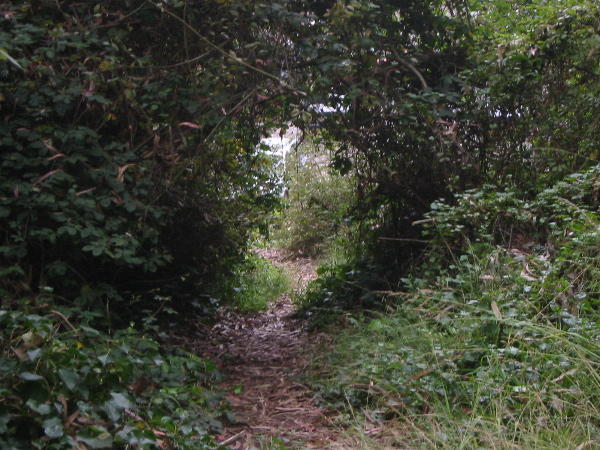
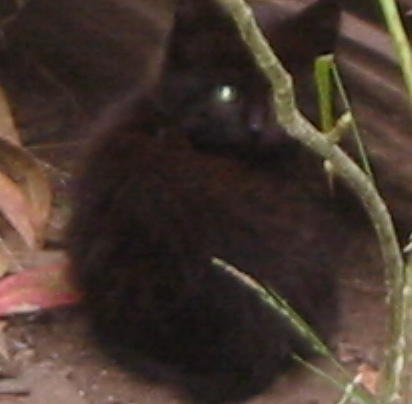
slowly, slowly, finding the places that could make San Francisco feel like home to me. Many more of these cats roamed the paths.
into thin air
I just watched this movie about climbing Mt. Everest. 5 people die. A lot of wandering around in the snow, not being able to think very clearly.
Sometimes my research feels like this. Probably it means I should take a break. But sometimes doing the simplest things are so much effort. Getting the signs right in these perturbed eigenvectors and eigenvalues. Its a somewhat hard calculation. But I keep making mistakes. I fix them in some parts of the paper and not in others. Then I make new mistakes.
Yes, sometimes trying to make progress is like making a run for the peak... if you use too much energy on the way up, coming down can really fuck you up.
Sometimes my research feels like this. Probably it means I should take a break. But sometimes doing the simplest things are so much effort. Getting the signs right in these perturbed eigenvectors and eigenvalues. Its a somewhat hard calculation. But I keep making mistakes. I fix them in some parts of the paper and not in others. Then I make new mistakes.
Yes, sometimes trying to make progress is like making a run for the peak... if you use too much energy on the way up, coming down can really fuck you up.
Subscribe to:
Posts (Atom)